Archive for the 'Poetry Friday' Category

Poetry Friday: Light Caught Inside

h1 Friday, May 9th, 2008

I’m going to stray a bit this week from the usual share-a-random-poem moments on Fridays, which are always lovely, and tell you about two new picture books: The second is written in rhyme (rhyme that won’t make you want to gag)—and it just so happens that it’s an exemplary book for the wee, wee, wee’est in your life—and the first is by a picture book author who has been reading and writing poetry with children for many years (and who is also a visiting poet in schools), Susan Marie Swanson. And a beautemous book it is, indeed. I also snagged a spread from each book so that I can show you some of the art work inside.
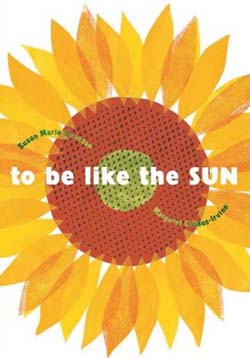
To Be Like the Sun by Susan Marie Swanson and illustrated by Margaret Chodos-Irvine (Harcourt, April 2008) is written, it’s safe to say, in a free verse style (I see that School Library Journal refers to it as free verse, too—“lyrical free verse,” at that). In this luminescent book, which celebrates both the sensual and abstract joys of summer, a young girl ponders a little sunflower seed in her hand:

“Hello, little seed,
striped gray seed.
Do you really know everything
about sunflowers?”

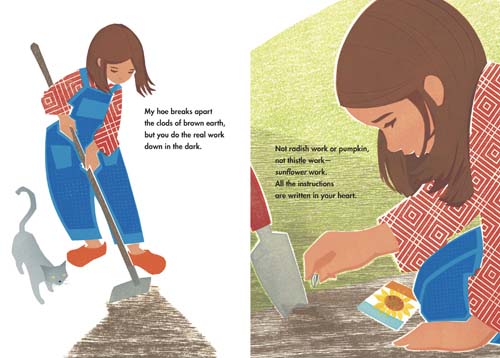
The girl then proceeds to break up the earth to plant her seed, considering the “real work down in the dark” the seed does:

“Not radish work or pumpkin,
not thistle work—
sunflower work.
All the instructions
are written in your heart.”
Read the rest of this entry �

Poetry Friday: Lilac Wine

h1 Friday, May 2nd, 2008

pretty, pretty lilacsRemember last weekend, when I went on the Wine and Herb Fest tour? It turns out a lot of the wineries here in the Fingerlakes do specialty fruit wines. Rhubarb, strawberry, pear, apple, peach, blackberry, cherry… Anything you can think of. Some of it is so sweet it drifts over into cordial territory, but a few of them were really quite lovely.
For some reason, the first time someone said the words “rhubarb wine,” the Jeff Buckley version of the James Shelton song “Lilac Wine” popped into my head. And, as the lovely spring weather has continued and actual lilacs are starting to bloom around here, the song has stayed in my head all week. I happen to love it, so I’m not complaining. In fact, I think I’ll share it with you for poetry friday. Here’s the first couple of verses:

I lost myself on a cool damp night
Gave myself in that misty light
Was hypnotized by a strange delight
Under a lilac tree

I made wine from the lilac tree
Put my heart in its recipe
Makes me see what I want to see
And be what I want to be

You can read the rest of the lyrics here. But really, this is a song that needs to be heard, not read. I know a lot of artists have covered it, but the only one I’m really familiar with is Jeff Buckley. *sigh* Man, I did love to hear that man sing.

Here’s an oddly hypnotic video someone made for the song. I like it in a way – it suits the mood, and lets the song take the focus. But don’t watch too closely, or you’ll realize you’re passing same tree over and over.

The always-poetic Kelly is handling the Poetry Friday roundup over at Big A little a. Poetry goes very well with wine, you know. Works with white or red… even champagne. Especially with that little strawberry in the bottom of the glass? I love that. Right, anyway… go on over to Kelly’s and see what everyone else is sharing today.

Jan Greenberg’s Side by Side

h1 Thursday, May 1st, 2008

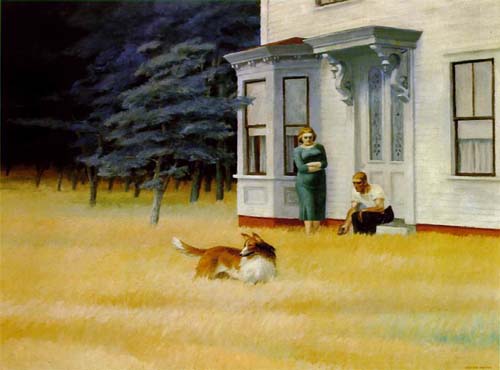
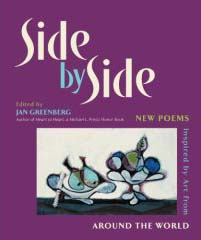
Want to see something neat? Ekphrasis. Ekphrasis, I tell ya. That means, essentially, poetry inspired by art, and it’s my new favorite word. Little did I know there was a word for this. Ekphrasis. I like saying it. Here’s some ekphrasis in action, and it comes from Side by Side: New Poems Inspired by Art From Around the World (Abrams Books for Young Readers, May 2008), which I’ll tell you about in a moment. This is an anthology edited by Jan Greenberg, who brought us—amongst a handful of great titles—the Printz Honor Book, Heart to Heart: New Poems Inspired by Twentieth-Century American Art (Abrams, 2001).

For the record, I’m re-printing these two poems with permission from the publisher, and this Edward Hopper painting falls under Fair Use and all that fun stuff. Also, I know these poems are HUGE, but WordPress won’t cooperate when I need to type poems with unusual formatting / spacing / indentation, so I have to basically type them into Word and make them images. Anyway, moving on…


Edward Hopper. Cape Cod Evening. 1939. Oil on canvas.

Read the rest of this entry �

Poetry Friday: The Poets Upstairs…

h1 Friday, April 25th, 2008

Hey, I think it just moved. Did you see it?There are serious perks to having poets for upstairs neighbors. Like, they loan me books. And take me to readings by excellent authors. And invite us up to play Rock Band. And introduce me to hilariously surreal products on a cool new blog.
Also, I keep thinking someday I’m going to write something with the title “The Poets Upstairs” because I just like saying it. So it’s inspiring, too. For now, I get to use it as the title of this post, because one of them had a poem published recently in Goblin Fruit, and it’s so great I had to share it with you guys.

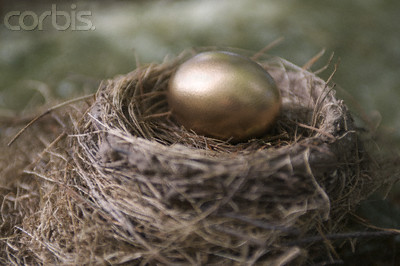
Goblin Fruit, in itself, is worth your attention. It’s a journal devoted to “poetry ‘of the fantastical,’ poetry that treats mythic, surreal, fantasy and folkloric themes, or approaches other themes in a fantastical way.” Really, really good stuff there. And the Spring 2008 issue includes, front and center, the very fairy-tale-ish “Nesting” by Dana Koster:

When you are born I will say: love me
as I loved my own mother — desperately,
as though love could stitch a path to the dead

and I will guard you with the greed of ancestry…

Read the rest here (you’ll have to click on the poem’s title). I love the whole concept of this poem – it feels like the beginning to a great story. The bird/egg imagery hints of the Leda myth. But the lines about the desperate love of a mother and the loss of a year for each question asked remind me of all those fairy tales (Thumbelina, Momotarō, the Gingerbread Man, etc.) that start off with a lonely woman who wants a child so very badly… and she gets it (or at least, something almost a child). But there’s always a catch, a price to pay, something lost in the bargain.

This is maybe the best perk yet from The Poets Upstairs. Hope you enjoy it too.

* * * edited to add: * * *

Today’s Poetry Friday roundup is being hosted by Tricia of The Miss Rumphius Effect. Git along, lil’ dogies.

Also, because I think Dana would particularly appreciate it, check out this version of the Leda myth I accidentally stumbled upon. I don’t know what this guy’s deal is, but when you click on the image links, you get photos featuring anatomically-correct ersatz-Barbie dolls posed as mythological characters. Ew.

Poetry Friday: An Interview with The Poetry Seven (Or, Cutting Loose Over Cutting a Swath)

h1 Friday, April 18th, 2008

Last week on Poetry Friday, you may have seen the unveiling of one mighty creative collaborative poetry project, a sonnet entitled “Cutting the Swath.” It was written by seven women—authors, teachers and/or librarians, poets, bloggers—who each wrote one verse in the sonnet and then put them all together and edited it into what is called a crown sonnet. Those women are Sara Lewis Holmes, Laura Purdie Salas, Tricia Stohr-Hunt, Liz Garton Scanlon, Tanita S. Davis (TadMack), Andromeda Jazmon (Andi), and Kelly Fineman. As Liz explained it in her post last week, in which the sonnet in its entirety was shared:

A Crown Sonnet is a string of seven interconnected sonnets. Each sonnet after the first one will use the last line from the preceding sonnet as its first line. The final sonnet (#7) uses the last line of sonnet six as its first line AND the first line of the very first sonnet as its last line. The perfect book-end.

As I read this sonnet, I (Jules here) found myself wishing I were only The President of the World and could command the editors of Time Magazine or, I dunno, even Rolling Stone (these women are rock stars, you know, for doing this) or some such major publication to do a cover story on this. ‘Cause . . . . well, WOW. No matter what you think of the final product—the force of nature that is the sonnet itself these women created—the process of collaborating thusly is pretty amazing, and so I thought the least I could do was talk to them about it. 7-Imp may not have the readership Time does, but perhaps some of our readers might be interested in this idea of collaborative writing. Yes, this post rivals the length of a novella (I didn’t want to cut corners on Cutting a Swath), but if you’re interested in the workings behind such a massively creative project, as I am, then this might be just the read for you: Settle down. Get a cup of coffee. And read for a bit.

Read the rest of this entry �

Poetry Friday: “Very old souls” (in adolescent bodies) on the nature of things

h1 Friday, April 11th, 2008

*******

Pictured, left:
MORNING SCENE IN MY HOMETOWN
by Jeane Renee T. Nubla,
age 14

* * * * * * *

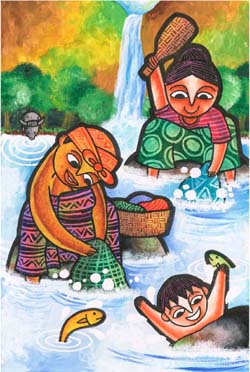
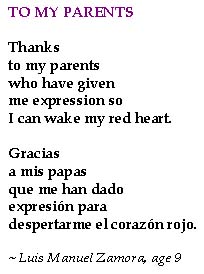
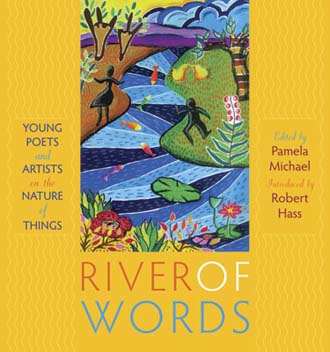
I suppose it’s possible that reading poetry crafted by children is not for everyone. But I believe that if it’s done well—and presented well—then you might experience what Barry Lopez describes when talking about the new poetry anthology I have the distinct pleaure of telling you about today, River of Words: Young Poets and Artists on the Nature of Things, edited by Pamela Michael and with an introduction by Robert Hass (Milkweed Editions; March 2008): “To turn these pages—to gaze and peruse here— is to discover an unfamiliar joy. These young people offer transcendence, enchantment, and the experience of human attainment—sensations adults too often, now, lose track of.” Having just finished this impressive new poetry collection, I concur entirely with Mr. Lopez. This is a beautifully-designed collection of thought-provoking, nuanced, and sometimes breathtaking poems—all written by children or teens.
Read the rest of this entry �

Poetry Friday: Cold Spring

h1 Friday, April 4th, 2008

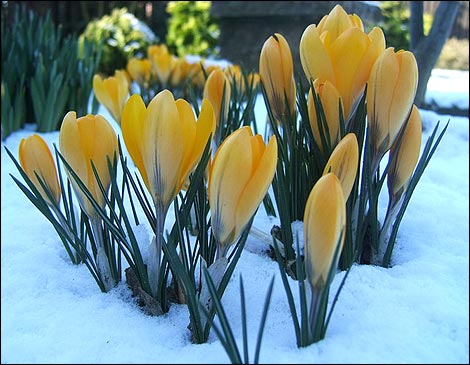
crocuses in the snow

Hellooooooooooooooooo, spring!

This morning, on my way to work, I finally saw some crocuses starting to bloom, and I think until that moment I hadn’t realized just how bad I needed to see something green. I almost cried with relief.

I really, really like winter. And snow. No, serious, I do! What I don’t like, weather-wise, is too many days in a row of the same thing. This winter felt like one long five-month stretch of 30-degree-highs, grey skies, and fitful snow flurries, punctuated by an occasional serious snowstorm that would coat everything in prettyness for a few hours, but ultimately just add another layer to those icy piles of crud that build up along the edges of the sidewalks.

Yeah, I needed a little green already.

This week I got it. Not just the crocuses – there’s grass! Buds on tree branches! There’s even little spiky blades of stuff that might be daffodils and tulips soon! (I know, people, we don’t even have daffodils yet – see how bad it is?)

We can’t get too cocky about it yet, though. It’s still cold. Sure, it’s sunny, but there’s a fierce wind out there that does not permit the shedding of coats and scarves. Not just yet. But that’s okay by me – the sun and the green are enough for now. They’ve shaken me out of my winter huddle-under-a-blanket-drinking-cocoa doldrums. It feels like change out there, like newness, like possibility, like the start of something… and it makes me want to start something too. It makes me want to stand up, toss that blanket on the couch, stretch, look around, and… I dunno, misspend whatever’s left of my youth?

It’s the kind of weather that makes you wonder where the past year has gone – for that matter, where the past 34 years have gone. It makes you wonder if you’re wasting your life away; wonder if you could be doing more, living more. Maybe it’s time to figure out what you really want to do with the rest of your life, and just go do it already.

I love it when I find a poem that perfectly expresses what I’m feeling right at that moment. Today it’s “Cold Spring” by Lawrence Raab:

Read the rest of this entry �

National Poetry Month: Big Talk from J. Patrick Lewis and What Happens When Poetry Meets Fabric

h1 Thursday, April 3rd, 2008

I promise to talk about books-longer-than-32-pages relatively soon, but today I’m sharing a few more picture book titles in honor of National Poetry Month. Let’s get right to it.

“The Stone Skipping Record”
by J. Patrick Lewis

* * *

The pebble made rough music,
Humming past a tiny
Island in the Blanco
River.
Touch tone, touch stone.
You could count the beats more or less

Evenly.
It was easy—
Guess
How many times
The pebble dimpled the water.

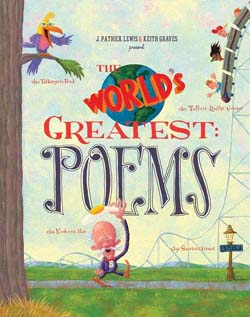
That is a poem from the latest poetry anthology from the prolific children’s poet, J. Patrick Lewis (and many thanks to him for permission to post it in its entirety here). Entitled The World’s Greatest: Poems (Chronicle Books; January ’08) and illustrated by Keith Graves, it’s the title for that student / child you know who gets inordinately excited over record books, such as Guinness, and who likely has an affinity for hyperbole (and possesses excessive spastic energy, to boot). It’s a lot of fun, this book is. And Graves’ light-hearted illustrations are a fitting match, everything a bit embellished, impossibly preposterous, utterly absurd, and wonderfully hammy.

Read the rest of this entry �

Kicking Off National Poetry Month
with Julie Larios and Julie Paschkis

h1 Tuesday, April 1st, 2008

No foolin’! It’s April 1st, and that means it’s National Poetry Month. This makes April one of the best months in the year, in my book, no matter what T.S. Eliot said. I’m here to celebrate today with the new picture book poetry anthology from Julie Larios and Julie Paschkis, Imaginary Menagerie: A Book of Curious Creatures, published by Harcourt this month.

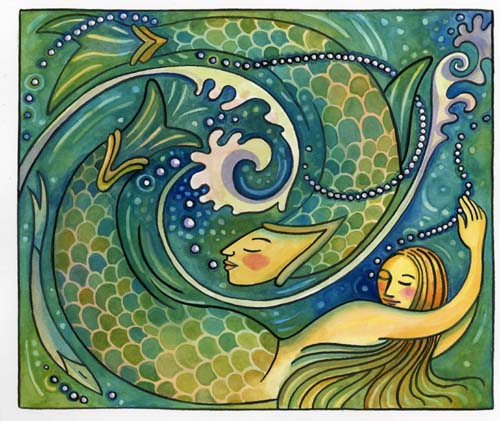
Just check out this swirling, visual delight from Paschkis (used with permission), an illustration which comes straight from this title:

That’s part of “Mermaid,” one of Larios’ many poems celebrating a handful of creatures from a mythological world. You’ll meet a dragon, a centaur, the firebird, a sea serpent, a gargoyle, the naga of seven heads, and much more. Below is Paschkis’ depiction of a cockatrice, whom Larios describes as “a snake-tailed rooster . . . a rooster-headed snake,” who isn’t quite sure if he should crow or he should hiss:

Read the rest of this entry �

Poetry Friday: Forgetfulness

h1 Friday, March 28th, 2008

Jules here. My turn for Poetry Friday was last week, but Eisha graciously helped me out and posted instead, ’cause I was having a busy week. And she was going to post this week, too, since I’m travelling for work as you read this (which means I won’t be able to respond to comments, should there be any, as I’ll be company meeting’ing all day in Boston). However, I went ahead and typed my Poetry Friday entry early, as I was inspired by something — and so that Eisha could get a Poetry Friday break, too.

I talked to my mother today (Tuesday, as I type this), and she was telling me the state of my grandmother, Grace, who is in a nursing home near where my parents live. They visit Mom-Mom just about every day, and my mother told me that she sleeps more and more and seems to be getting smaller. She’ll be 97 this year, so this is not a surprise. She’s most certainly nearing the end of her long life, and her memory went several years ago. She might be able to tell you the name of the road she lived on when she was eleven, but I’ll walk in the room and she won’t recognize me or my daughters.

Read the rest of this entry �