Poetry Friday: Confluences come when they will… or, how to get from Lucinda Williams to the Siege of Leningrad in a single blog post
 Friday, March 21st, 2008
 Here’s something you might not know: Lucinda Williams, an excellent songwriter for whom Jules and I share a deep and abiding love, is the daughter of a poet. I think I had maybe read that in an interview or two, long ago, and then more or less forgot about it. But I recently stumbled across this article about the two of them, and my interest was piqued. So I looked up Miller Williams, and I found out that he read a poem at President Clinton’s second inauguration. I also discovered this poem, “The Curator.”
There are images here that will haunt me for the rest of my life. Seriously.
The poem takes place during the Siege of Leningrad in WWII. The narrator, a young curator at the State Hermitage Museum (Did you see Russian Ark? Yeah, that place), describes how the museum staff had prepared for the German onslaught by packing up the paintings and storing them elsewhere. But they left the frames hanging on the walls to make it easier to rehang the paintings when it’s safe again…
Nothing will seem surprised or sad again
compared to those imperious, vacant frames.Well, the staff stayed on to clean the rubble
after the daily bombardments. We didn’t dream—
You know it lasted nine hundred days.
Much of the roof was lost and snow would lie
sometimes a foot deep on this very floor,
but the walls stood firm and hardly a frame fell.Here is the story, now, that I want to tell you.
Early one day, a dark December morning,
we came on three young soldiers waiting outside,
pacing and swinging their arms against the cold.
They told us this: in three homes far from here
all dreamed of one day coming to Leningrad
to see the Hermitage, as they supposed
every Soviet citizen dreamed of doing.
Now they had been sent to defend the city,
a turn of fortune the three could hardly believe.I had to tell them there was nothing to see
but hundreds and hundreds of frames where the paintings had hung.“Please, sir,” one of them said, “let us see them.”
And so we did. It didn’t seem any stranger
than all of us being here in the first place,
inside such a building, strolling in snow.
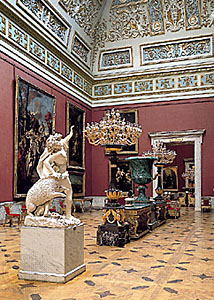 There’s one of the images that has seared itself into my brain: soldiers, standing in an opulent gallery strewn with rubble and snow, staring at empty picture frames while the curators… well, you really must read the rest of the poem. Goosebumps guaranteed.
Apparently this is based in fact, too. Here’s an article from an exhibition at the Hermitage about the Siege years that describes what life was like for the curators:
“The museum not only withstood the bombings, but continued its routine work, safeguarding its exhibits and buildings, hosting surrealistic tours of its vacant halls… The starving defenders of the Hermitage found solace in the thought that core collections would survive though they themselves might die.”
Amazing, isn’t it? What a story. And what a poem. And what a weird confluence of topics in this one blog post.
Poetry Goddess Elaine is on round-up duty at Wild Rose Reader. Do check out the other entries, if you haven’t already.
 For the past couple of days I’ve been fighting off a raging blue funk. No particular reason, really – just a combination of seasonal affective disorder, travel fatigue, the endless grind of the job search, politics, world events, Dreamweaver 8, and… okay, fine, I’ll say it: PMS.
  As
As  I mentioned a couple of weeks ago that I’d seen

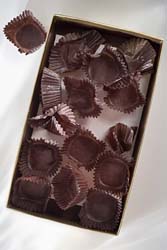 Happy Day-After-Valentine’s Day! I hope you all managed to fit in a little quality time with your significant others, or at least ate a bunch of chocolate.
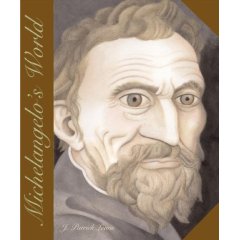 First things first, then: Last year, Creative Editions released
  I had something of a religious experience last weekend: I saw
 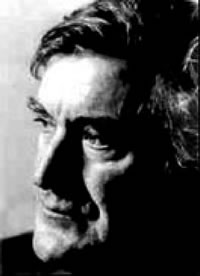 “Because it is occasionally possible, just for brief moments, to find the words that will unlock the doors of all those many mansions inside the head and express something — perhaps not much, just something — of the crush of information that presses in on us from the way a crow flies over and the way a man walks and the look of a street and from what we did one day a dozen years ago. Words that will express something of the deep complexity that makes us precisely the way we are, from the momentary effect of the barometer to the force that created men distinct from trees. Something of the inaudible music that moves us along in our bodies from moment to moment like water in a river. Something of the spirit of the snowflake in the water of the river. Something of the duplicity and the relativity and the merely fleeting quality of all this. Something of the almighty importance of it and something of the utter meaninglessness. And when words can manage something of this, and manage it in a moment, of time, and in that same moment, make out of it all the vital signature of a human being — not of an atom, or of a geometrical diagram, or of a heap of lenses — but a human being, we call it poetry.
 There’s this wonderful episode of
  Thanks, as usual, for indulging me. Next week we’ll have some proper poetry, I’m sure.