Archive for the 'Poetry Friday' Category

Poetry Friday: I’m Going as a Witch This Year.
How ‘Bout You?

h1 Friday, October 24th, 2008

“Beware of where you’re going,
Beware of where you play,
Beware of werewolves everywhere—
Halloween is on the way!”

I’m throwing a Halloween party tonight (wish you could come over for some hot cider and hot apple crisp with ice cream and orange cupcakes, mmmmm), so I’m in the mood for some Halloween poetry today. And, in honor of the children who will be in my house tonight, I’m going to share some Halloween children’s poetry.

Read the rest of this entry �

Poetry Friday: Shakespeare to Seoul

h1 Friday, October 17th, 2008

A Midsummer Night’s Dream, as performed by Yohangza Theatre Company from Korea. This has nothing to do with what my husband is doing in Seoul, but it looks cool. Click to learn more.My husband happens to be in Seoul, South Korea at the moment. I took him to the airport Wednesday morning, and he’ll get back on Monday afternoon. It’s not that long to be apart, especially for us – he’s a theatrical set designer, and frequently travels for weeks at a time for his design gigs. But it is definitely the farthest apart geographically that we have ever been – even before we knew each other. So I’m feeling a little sentimental, and wanted to choose something with him in mind. Here’s Sonnet XCVII from the patron saint of all thespians, William Shakespeare:

How like a winter hath my absence been
From thee, the pleasure of the fleeting year!
What freezings have I felt, what dark days seen!
What old December’s bareness everywhere!
And yet this time remov’d was summer’s time,
The teeming autumn, big with rich increase,
Bearing the wanton burthen of the prime,
Like widow’d wombs after their lords’ decease:
Yet this abundant issue seem’d to me
But hope of orphans and unfather’d fruit;
For summer and his pleasures wait on thee,
And thou away, the very birds are mute;
Or if they sing, ’tis with so dull a cheer
That leaves look pale, dreading the winter’s near.

* * * * *

My ol’ pal Becky at Becky’s Book Reviews (who has the most beautiful header in all of book-blogdom) is handling the Poetry Friday round-up this week. Do pay her a visit, won’t you?

Poetry Friday: For My Brothers

h1 Friday, October 10th, 2008

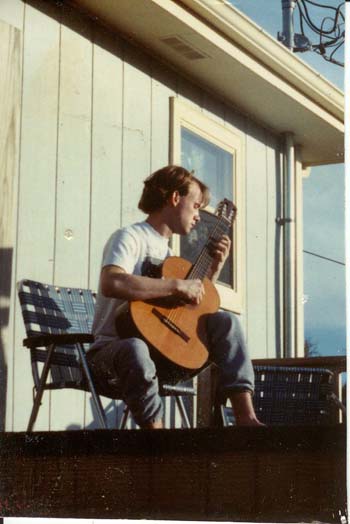
Yesterday would have been my brother Donnie’s 38th birthday. I miss him fiercely.

He was many wonderful things to many people and brightened others’ lives in many ways, and one of the things he did was play classical guitar. He had just taken a break from earning his doctorate at The University of Memphis when he died. He made beautiful music. There are lots of pictures of him at recitals, all decked out in a tux. But this battered old one here, which I just scanned after I pulled it out of its frame, has always been my favorite. It’s a picture of him that someone snapped probably without him knowing it. He’s playing on the back deck of the little house we lived in when we were in high school. Bless my soul and yours, too, wasn’t he handsome?

This poem has always made me think of the way he played. I think I’ve shared it before here—maybe possibly perhaps—but it’s a beautiful piece of writing, always worth sharing again: Read the rest of this entry �

Poetry Friday: Charles Simic can visit my library any time.

h1 Friday, October 3rd, 2008

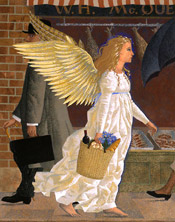
Illustration from The Possibility of Angels by Peter Malone.I just saw Charles Simic, recent Poet Laureate, give a reading at Cornell. He was amazing. I don’t know what I was expecting, but I didn’t expect him to be so… funny. I don’t think I really got his poetry until I heard him read it. He’s got this fabulous mix of accents from a well-traveled life: childhood in Yugoslavia, youth in New York City and Chicago, and now he lives in rural New Hampshire. And in a brusque, matter-of-fact, self-deprecating way, he told these stories about how he came to write the poems he read. For example, his book of prose poetry, The World Doesn’t End, came about because he had to write a four-page autobiography for an encyclopedia, and he kept imagining “more interesting versions” of his own life. His delivery just made everything click for me. As the professor who introduced him said, if you are not familiar with his poetry and books, your life is diminished – but don’t worry, that’s what bookstores and libraries are for. I would have added – and Poetry Friday.

So here I am, doing my part, sharing one of the poems he read. It has now become one of my favorites, for obvious reasons. It’s called “In the Library”:

There’s a book called
“A Dictionary of Angels.”
No one has opened it in fifty years,
I know, because when I did,
The covers creaked, the pages
Crumbled. There I discovered

The angels were once as plentiful
As species of flies.
The sky at dusk
Used to be thick with them.
You had to wave both arms
Just to keep them away.

Click here to read the rest, so you’ll know what I mean when I say:

Oh yes, the books are whispering. I hear them too, Miss Jones.

* * * * * * *

Guess who’s on Poetry Friday round-up? It’s Stacey and Ruth at Two Writing Teachers. Ya’ll know it’ll be good.

Poetry Friday: The Breathing Respect You Carry

h1 Friday, September 19th, 2008

William StaffordDo you ever read a poem that just absolutely blows you away and you want to yawp about it barbarically on the rooftops of the world but then wonder, hmmmm, did everyone else read this poem when they were, like, two years old and they’re all, ‘Oh please, Jules. I can recite that’? Well, that may be the case today, but this poem is new to me.

It’s called “You Reading This, Be Ready” by American poet William Stafford, pictured here. I have author John E. Simpson to thank for it (this blogger, who goes by “JES”), who apparently frequents Haven Kimmel’s blog, as Eisha and I do. Over at her blog—where my oh my she likes to ask The Big Questions on a regular basis—she asks this week, how are we to live? She shares “the walls of the house” she lives in and then asks her dedicated readers, how are you to live? John’s response was to share this poem, and I saw it there, since I read the comments at Haven’s blog about as devotedly as I read her posts. And I just about passed right the hell out, wondering where—and I mean OH WHERE?!!!—have these words been all my life? I had never seen before this brilliant, little prayer of a poem.

Read the rest of this entry �

Poetry Friday: Bashō x 3

h1 Friday, September 12th, 2008

And now, your moment of zen.Wanna see something cool?

Remember a couple of weeks ago I featured the poem by Sappho, and linked to a page that showed a bunch of different translations of it? It got me kind of interested in the whole process of translating poetry into English, and what vastly different interpretations can result from different translators. Well, I found a web page that shows several of Bashō’s haiku, as translated by three people: R.H. Blyth, Lucien Stryck, and Peter Beilenson. Here’s an example:

Blyth:

From time to time
The clouds give rest
To the moon beholders.

Stryck:

Clouds –
a chance to dodge
moonviewing.

Beilenson:

Glorious the moon
therefore our thanks, dark clouds
come to rest our necks.

Wild, isn’t it? I think my favorite is the first one — it’s simple and elegant, which is what I generally appreciate about good haiku. But the Stryck version has a sardonic appeal, too. Beilenson’s is a little florid compared to the other two.

For even more adventures in comparing translations, here’s 30 different versions of Bashō’s frog haiku.

* * * * * * *

Need more poetry? Of course you do. Go see what the other Poetry Friday posters are up to at Jennie’s Biblio File.

Poetry Friday: Brewin’ the Blues

h1 Friday, September 5th, 2008

When I worked as an educational sign language interpreter, I can’t tell you how many classes I interpreted at the college level — even the graduate and post-doctoral level (not because I’d have to kill you if I told you, but because it seems like I did a lot). One of them was a Women’s Studies course, and I remember the students had to give presentations on the life of a famous woman (I’m sure the assignment was more complicated than that, but I don’t remember the hand-flapping details of that one). One student presented on the life of Billie Holiday, and I remember thinking: Damn. She had it bad. Reeeeeal bad. Raped at the age of ten, frequent visits to a Catholic reform school and a mother who could hardly take care of her, a hard drug addiction, jailed on drug charges, relationships with abusive men, and much more.

But that’s not much to remember. Hey, you take your Latin courses, your Epidemiology, your Theatre History, your Anatomy, your Sports Psychology, and your Trig—all of which I interpreted plus some—and you forget the details. But I do remember thinking, I’ve GOT to get a good biography on Billie, whose music I’ve always lurved.

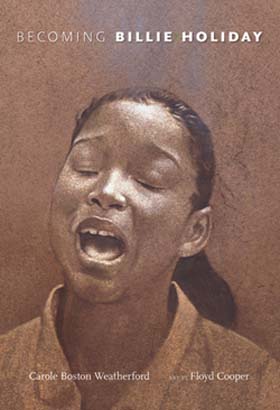
Lucky for me, the insanely talented poet and children’s book author Carole Boston Weatherford has just written what she calls a fictional verse memoir of Billie’s life, Becoming Billie Holiday (Boyds Mills Press/Wordsong, October 2008), Weatherford’s young adult book debut with illustrations from Floyd Cooper. Read the rest of this entry �

Poetry Friday: Sappho

h1 Friday, August 29th, 2008

I’ve been rereading Salinger this week, which means I’ve been reading a lot of references to Sappho. I know, she’s a weird choice for Poetry Friday, because we only really have one complete poem from her, and then a bunch of tantalizing fragments that are kind of hard to quote effectively. But whatever. Read the one we have, and weep for what has been lost:

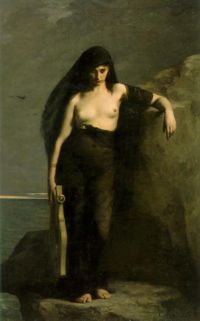
Sappho by Charles Mengin“The Hymn to Aphrodite” (Fragment 1; literal translation by Henry Thornton Wharton)

Immortal Aphrodite of the broidered throne, daughter of Zeus, weaver of wiles, I pray thee break not my spirit with anguish and distress, O Queen. But come hither, if ever before thou didst hear my voice afar, and listen, and leaving thy father’s golden house camest with chariot yoked, and fair fleet sparrows drew thee, flapping fast their wings around the dark earth, from heaven through mid sky. Quickly arrived they; and thou, blessed one, smiling with immortal countenance, didst ask What now is befallen me, and Why now I call, and What I in my mad heart most desire to see. ‘What Beauty now wouldst thou draw to love thee? Who wrongs thee, Sappho? For even if she flies she shall soon follow, and if she rejects gifts shall yet give, and if she loves not shall soon love, however loth.’ Come, I pray thee, now too, and release me from cruel cares; and all that my heart desires to accomplish, accomplish thou, and be thyself my ally.

* * *

Click here for this translation, as well as several attempts to translate it into verse. I like the straight-up version best, though.

* * *

Charlotte’s got this week’s Poetry Friday round-up over at her Library. Check it out. (Sorry, bad pun.)

Poetry Friday: Recipe for Green

h1 Friday, August 22nd, 2008

We had so much fun with our Jane Yolen interview this week that we thought we’d top off the week with one of her poems. If you missed our interview, you’ll see that she shared two as-yet-unpublished ones with us, so head over there if you missed those. The below poem is from Here’s a Little Poem: A Very First Book of Poetry, a wonderful collection of poems for the very young, collected by Jane and Andrew Fusek Peters and illustrated by Polly Dunbar. The 7-Imp love for this anthology has been fierce — here’s a review, and here’s our interview with Polly Dunbar (not to mention I’ve run my mouth about this book in many other posts here, and I’ve bought a copy for each and every baby shower I’ve attended since the book was released. It’s the perfect gift for a wee newborn, the best to-grow-with-them gift).

Here’s one of my favorite poems from the book, Jane’s “Recipe for Green”: Read the rest of this entry �

Poetry Friday: Savage Machinery

h1 Friday, August 15th, 2008

I’ve started reading an early copy of poet Karen Rigby’s forthcoming chapbook, Savage Machinery, to be published next month by Finishing Line Press. As Rigby describes it at her site, Savage Machinery explores 15th and mid-century art (heavy on Edward Hopper), eros, women, and the pleasures of taste (there are a handful of food poems).

On the latter note, here is, arguably, my favorite poem in the collection thus far (let me stress the “thus far” — I have a bit more reading and some re-reading to do), since I got Karen’s permission to share a couple of the poems in their entirety. If, like me, you can see the sanctity in a simple piece of bread (Little Willow, I’m talking to you), you may have a fondness for this one, too:

“Bread”

Pitas swell, parachutes
in their ovens. On holidays, wreaths
braided with raisins.
I like a simple loaf best.
No olives greasy as pennies,
just dry crust flaking
in my hands, torn magnolias
clean and odorous
as bodies after love.
Salt spills like constellations
on my tongue. The first time a man
fed me bread, the pockets of air
were shutters opening.

Oh my and ooh la la! (How’s that for some scholarly poetry analysis?)
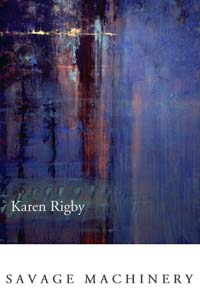
Poet Jim Daniels has said about the poems in Savage Machinery, “{i}t’s no accident that some of these poems reference Edward Hopper. Rigby’s language evokes his sparse, barren landscapes where emptiness is tangible, menacing, and beautiful. Her poems are so packed they bloom at the touch.” I love that, as I think it captures her poetry well, especially the bit I emphasized (yes, I emphasized it, not Jim).

These are poems that demand your attention and your careful reading, an appreciation of the craft that went into their creation. And Rigby has an observant eye, creating striking metaphors, bringing us a new awareness of what we thought we knew before, and it’s all like being given a gift. Of course, this is what poets do — create a new awareness in the reader, but Rigby does it with imagery that manages, in some turns, to be bold and spine-tingling all at once. These are poems beautiful, sensual, and strange, and I have felt compelled to re-read each one; they are that rewarding. And the chapbook’s opening poem, in all its strangeness and allurement, draws us in and sets us straight, in terms of what to expect further from Rigby: It’s about a woman bathing in a house mostly burnt-down — and the reactions from the neighbors (“Women envy her freedom. / Tease their husbands, saying church drives / and dry cleaning trips are white lies”).

Below is another poem to close us out, and thanks to Karen for permission to share two poems with you today. To read a few more of her poems online, visit this link at her site. Read the rest of this entry �