Archive for the 'Intermediate' Category

One Shot World Tour: O Canada! with Jessica Meserve and Martha Brooks

h1 Wednesday, March 26th, 2008

jules: It’s another multi-blog One-Shot World Tour Day (our most recent one being a visit to Australia with our Margo Lanagan interview last August, though I could have sworn we participated in another One-Shot Day. Ah well, moving on . . . ). Today several blogs will be writing about Canadian authors, and I thought I’d talk a bit about an illustrator whose work I think is one-to-watch, and that would be Jessica Meserve. Granted, she was born in New Hampshire, apparently, but she now lives in Edmonton, Canada. Just humor me here. I really want to tell you about this book.
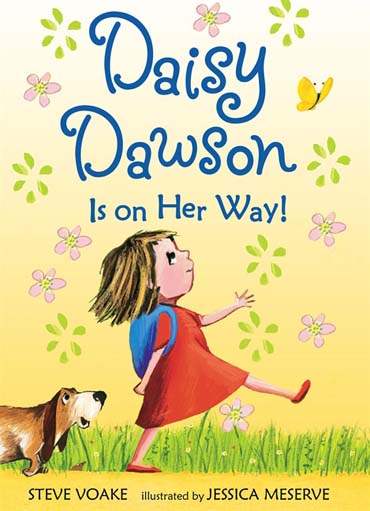
As I mentioned in this recent post about Jessica’s debut title (Small Sister; Clarion Books; May 2007), Meserve studied illustration at Edinburgh College of Art, worked in publishing as a children’s book designer, and is now freelance illustrating. And Jessica’s done the illustrations for a new early chapter-book from Candlewick, Daisy Dawson Is on Her Way! by British author Steve Voake (just released yesterday, according to this link).

And I’d like to say that this book will so entirely wrap you around its finger and not let you go. Fortunately for us all, the front jacket flap says that “Steve Voake introduces beginning readers to a little girl with a big heart.” Yes, that emphasis is mine, and color me jumping-up-and-down, since that statement indicates we might have a series on our hands here.
Read the rest of this entry �

100 Naked Summers

h1 Wednesday, March 19th, 2008

That title might be lame, but at least I got your attention, right? That’s a rather pathetic amalgamation of the three titles I’m going to review today. Yup, it’s time for a short round-up of some new middle-grade titles I’ve read recently. Let’s get right to it then…

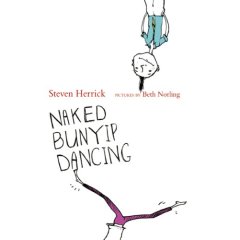
First off is Steven Herrick, Australian poet and free verse author, whose books I consistently adore, as I’ve made clear several times here at 7-Imp (see here for a review of The Wolf and here for By the River). Originally published in 2005 by Allen & Unwin, the first U.S. edition of Naked Bunyip Dancing has just been brought to us from Front Street. I know that free verse can be so used and abused that many of our loyal readers perhaps get twitchy when even hearing the phrase, but with Mr. Herrick, you’re in good hands.

This novel chronicles the school year for one Australian classroom 6C, a group of students who are a bit in awe of their unconventional new teacher, Mr. Carey, who has a beard, wears “flared trousers / and beads / and a T-shirt with the slogan / Meat is Murder on the front / and McDonald’s = McJunk on the back.” In his introduction to the class, Mr. Carey plays some Bob Dylan (“who sounds like / he swallowed a bag of marbles / and got two stuck up his nose”). Before the bell rings, Mr. Carey — whom the class has quickly dubbed “Carey, the scary!” and “the bearded beaded one,” though “Carey the hairy” is the name that sticks — tells the class that he hopes they’ll sing together and read some poetry after lunch. Ahem. They’re a bit blindsided by this, but Carey the Hairy quickly wins the adoration and devotion of all the students with his candor and creativity. Read the rest of this entry �

Two Co-reviews: Our Favorite Freaks of Nature

h1 Monday, March 10th, 2008

Jules: Well, hello there on this Monday. I’m going to take a break from Nonfiction Monday today, as Eisha and I are trying to get caught up a bit here on reviews of a couple titles from last year. For no particular reason, other than sometimes just being slow, we have yet to talk about these two YA titles that we dug and dug hard.

Let’s get right to it, shall we?

Last August saw the release of Robin Brande’s first novel, Evolution, Me & Other Freaks of Nature, released by Alfred A. Knopf. This “ambitious YA debut” (Publishers Weekly) was met with critical acclaim and was chosen as a 2008 ALA Best Book for Young Adults; a Fall 2007 Book Sense Children’s Pick; and a 2008 NCSS/CBC (National Council for the Social Studies and Children’s Book Council) Notable Children’s Trade Books in the Field of Social Studies.

The novel tells the story of high school freshman Mena Reece. She’s cleared her conscience by doing what she considered the right thing (regarding a young man named Denny Pierce) by her friends, her church, and her family — but, as a result, none of them are speaking to her. Needless to say, her school year is not starting off well (“My life might really improve if I could just stop feeling so committed to the truth”). She does make one friend in her science lab partner, Casey, who happens to be brilliant as well as, Mena comes to realize, funny and cute and entirely not afraid to be himself. Since her former best friends have cut her off (“Ahh, that’s sweet—you made a new little gay friend already,” one of them tells her snidely), Casey’s pretty much all Mena has right now. And when her science teacher, Ms. Shepherd, begins a unit on the topic of evolution, Mena finds herself both fascinated by and caught up in a new controversy between those former best friends from the conservative church her family attends and those aligning themselves with Ms. Shepherd, trying to keep intelligent design from being taught in the school. As a result, Mena undergoes her own personal evolution, as she considers the subjects of religion, science, indoctrination, faith, freedom, and much more.

Read the rest of this entry �

Wings and Faith with David Almond and Polly Dunbar

h1 Wednesday, March 5th, 2008

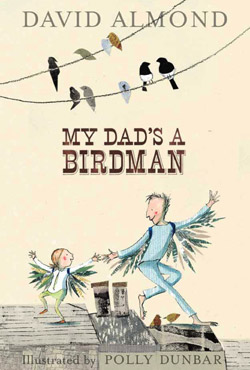
Let me hear it for David Almond, my friends. I really don’t think there’s anyone else quite like him writing for young adults today. He’s an extraordinary storyteller, creating stories memorable for their originality and striking in their beauty and mystery. His latest title is My Dad’s a Birdman (Candlewick; April ’08), an illustrated novel for younger readers with art work from one of my favorite illustrators, Polly Dunbar. And it “reads like a playful fairy tale,” wrote the UK’s Times Online. This is a relatively short, twenty-chapter illustrated novel for the 8+ age crowd, and it’s just such a lovely, lovely read. It’s tender and touching and celebrates life with an unabashed joy that made me instantly want to read it a second time, which I, indeed, did. I also found it to be rife with symbolism — but not in a Lit-101 kind of way that made me want to throw the book across the room. This is David Almond we’re talking about. He’s a master storyteller, and he handles the characters’ underlying grief with an impressive subtlety. But I’m getting ahead of myself . . .

Read the rest of this entry �

Seven Impossible Interviews #67: Sherri L. Smith

h1 Tuesday, February 26th, 2008

Here’s some food-for-thought:

“Take a minute to answer this question: If you had one last meal, what would it be? This is one of my favorite dinner party questions. The answer can tell you a lot about someone. Sure, people will ramble, name a dozen items, some of them gourmet dishes from a favorite restaurant, some of them once in a lifetime treats from a vacation overseas, but in the end, if they are like most people, they will end up naming something from their childhood. Something their mother used to make. You can understand, of course, the desire for comfort food if it is indeed your last meal. But, I think it is more than that. It’s an assertion of self, of our origins.”

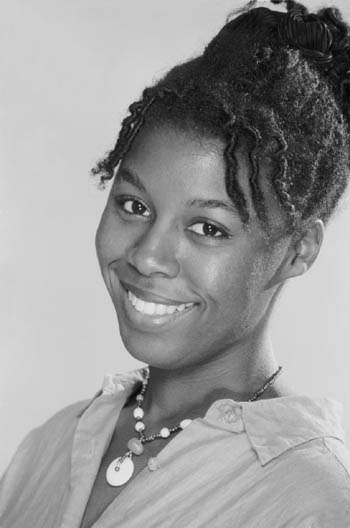
Those are the words of author Sherri L. Smith, taken from her guest post at The YA YA YAs last week. Her new YA novel — Hot, Sour, Salty, Sweet (Delacorte Press Books for Young Readers; February 2008) — touches upon the issues about which Sherri wrote in that guest-post: one’s origins, identity, self-assertion. The book tells the story of Ana Shen, who has what her social studies teacher calls a “marvelously biracial, multicultural family.” But to Ana, she simply has a Chinese American father and an African American mother (“Those are the bi-races. Calling them cultural or marvelous is a stretch, in Ana’s opinion. But that usually depends on the day”). Grandpa and Grandma White and Nai Nai and Yi Yi, both sets of grandparents, are in town to celebrate Ana’s big day, her eighth-grade graduation, as Ana prepares to make her salutatorian speech. But a broken pipe in the school, which shoots the roof off the building, has other plans. Read the rest of this entry �

Nonfiction Monday: Trailblazers of Swing, Strutting Their Stuff on the Bandstand

h1 Monday, February 25th, 2008

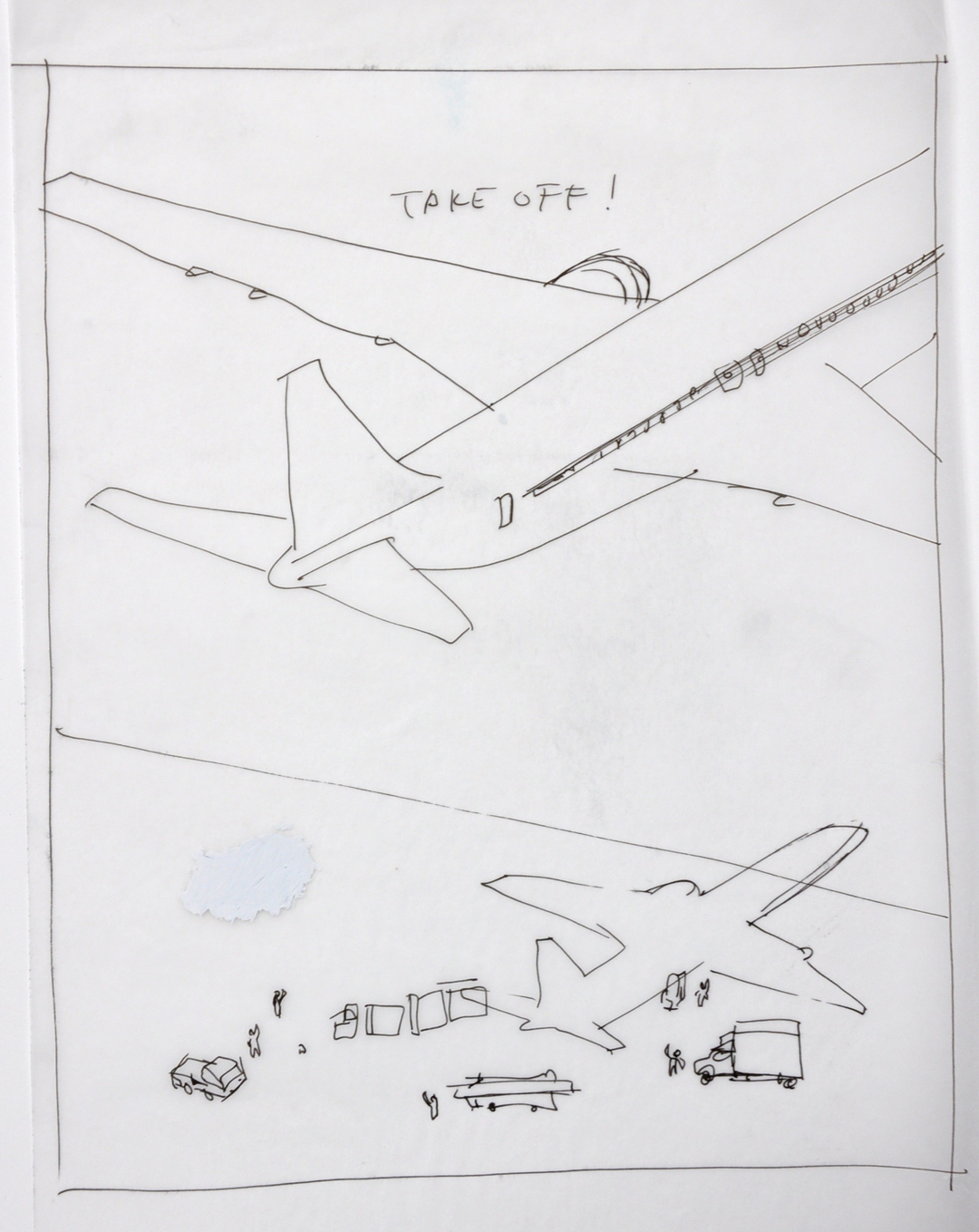
Last summer, Knopf Books released Tonya Bolden’s Take-off: American All-Girl Bands during WWII, and it’s taken me this long to review it. But that’s not because it lacks in any way: It’s a well-researched, engagingly-written piece of nonfiction. In fact, Bolden composes her narrative in true hep cat style, incorporating swing slang and a distinctive rhythm to her prose (in the introduction, while addressing the gap women filled after so many men were drafted into World War II, she writes, “{w}hat was a woman with a beat to do—a woman who’d rather riff than rivet? With scads of cats drafted and volunteering for military service, more chicks jumped at the chance to bandstand.”)

Read the rest of this entry �

Nonfiction Monday: Artist Wayne Thiebaud, Painting What is Overlooked, and Cakes, Cakes, Glorious Cakes

h1 Monday, February 18th, 2008

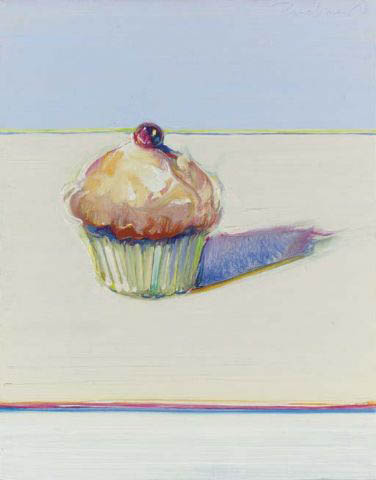
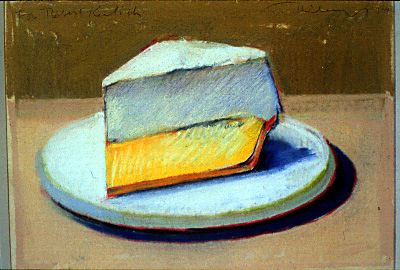
Valentine’s Day may have passed, but since you’re probably still reeling from (or still eating) some of the delicious treats that are part and parcel of the holiday, I thought I’d tell you on this Nonfiction Monday about Delicious: The Life & Art of Wayne Thiebaud by Susan Goldman Rubin and published by Chronicle Books in December of last year. In May of ’07, Rubin brought us — also via Chronicle Books — a board book for the wee-est of children (reviewed here at 7-Imp) of the art of Wayne Thiebaud, an American painter born in 1920 whose work is associated with the Pop Art movement. This time she gives us an over-one-hundred-page look at his life, officially geared at ages 9 to 12.
My heart belongs to any painter who has been quoted as saying, “Cakes, they are glorious, they are like toys.” Yes, Thiebaud is probably best known for turning to paintings of gumballs, cupcakes, pies, cakes, and other culinary ecstasies. Read the rest of this entry �

Seven Impossible Interviews Before Breakfast #66:
Lisa Graff drops by (again!); we weigh in on her new novel; and book give-away! RAH!

h1 Thursday, February 14th, 2008

{Note: It’s February 14th, and the Cybils ’07 award winners are being announced today over at the Cybils blog. 7-Imp can devote an entire post to this after a bit ‘o’ time has passed, but don’t miss the award announcements!}

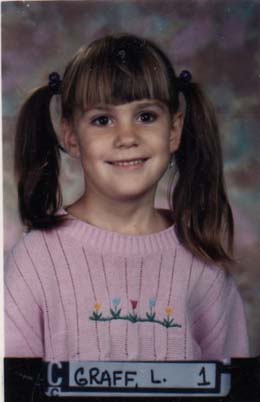
Jules: Hey, Eisha. Remember when Lisa Graff stopped by 7-Imp last year (almost one year to the date) to chat with us at the release of her first novel, The Thing About Georgie? She’s back for seven impossible things before breakfast (though I’m only awake enough right now for about three). There she is as a wee babe. Isn’t she puddin’? And she’s here to talk about her new middle-grade novel, The Life and Crimes of Bernetta Wallflower (Laura Geringer Books), which was just released at the end of January and which you and I just read. Best of all, she’s putting up with us throwing another weird-ass closing questionnaire at her, since she answered Pivot last year.

Bernetta is all about twelve-year-old Bernie who, after her supposed best friend (Ashley) implicates her in a cheating and blackmail scam, loses her private school scholarship. With the help of a new friend (with chocolate-brown eyes, ooh la la), Bernie spends the summer using her knowledge of magic and sleight-of-hand both to earn the $9,000 in tuition money and to get revenge.

What did you think of the book, Eisha?

eisha: Yes, she is a total puddin’!!! And I enjoyed this one a lot, Jules. Between this novel, and The Thing About Georgie, I’ve decided that one thing Lisa Graff can certainly deliver is an original concept. At heart, this is a story about friendship, trust, and finding one’s own identity and the limits of one’s own conscience. But told in the framework of a con job, complete with preteen con artists, magicians, and extortionists… It’s a great hook, and will certainly keep readers guessing along with Bernetta about who’s a friend, who’s an enemy.
I also love the attention to detail, and the fun little sleight-of-hand definitions and demonstrations.

How about you, Jules? What did you think? Read the rest of this entry �

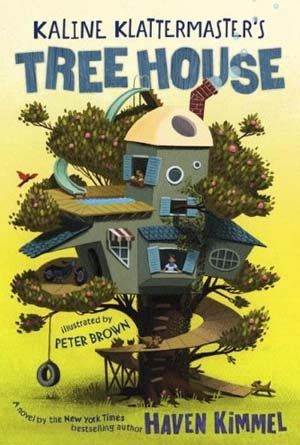
Co-Review: Kaline Klattermaster’s Tree House

h1 Monday, February 11th, 2008

Jules: If you’re a loyal reader of 7-Imp, you know Eisha and I have what could easily pass for a virtual fan club here at this blog for author Haven Kimmel, the creator of the two Zippy memoirs (this one and this one for which you should drop everything and read if you haven’t already) as well as the books in what is called her Hopwood Trilogy — The Solace of Leaving Early, her debut novel; Something Rising (Light and Swift); and last year’s The Used World (which Eisha and I co-reviewed at ForeWord Magazine’s Shelf Space in October of last year). More on those books and our undying devotion to her as an author are in this interview with her, conducted almost one year ago.
Haven has a new children’s book (geared officially at the “7-12” age range), just released at the beginning of February by Atheneum Books for Young Readers, with art work by Peter Brown (whom we heartily thank for sending us for our post today some of the interior art included in the book). It’s called Kaline Klattermaster’s Tree House. Needless to say, Eisha and I were pretty psyched about reading it. Despite what Publishers Weekly wrote in their review of the book, this is not Haven’s children’s fiction debut. In 2003, she penned the picture book Orville: A Dog Story, published by Clarion.

Read the rest of this entry �

Nonfiction Monday: Now I know my ABCs . . .

h1 Monday, January 28th, 2008

Author and teacher Anastasia Suen over at the blog Picture Book of the Day has randomly declared Mondays as Nonfiction Mondays for any bloggers who’d like to join in. Just like with Poetry Fridays, the idea is that, if you post about a nonfiction title on a Monday and send her the link, she’ll round ’em up over at her blog and, voila! You’ll have a cornucopia of posts about nonfiction titles.

I, for one, love this idea. I can still hear the words of one of my grad school children’s lit profs, knocking around in my head, reminding me that librarians, print journals, etcetera and yadaya don’t give enough attention to nonfiction titles. ‘Tis certainly true here at 7-Imp. Arguably, we should devote more to it than just one designated day a week. But for now I’ll leave it to an author who writes nonfiction to help whip me into shape with, at the very least, some Monday posts about nonfiction — when I can get to them, that is.

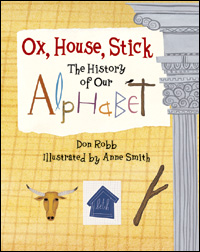
And here’s a fabulous nonfiction title I’ve been wanting to blog about for a while. It’s called Ox, House, Stick: The History of Our Alphabet by Don Robb and illustrated by Anne Smith, published by Charlesbridge last year. As the Booklist review pointed out, this title will find a happy home in both social studies and language-arts units. In describing the development of our Roman alphabet from the time of early Sinaitic peoples approximately 4,000 years ago to the present day, the book covers a large scope yet impresses with its conciseness. And the aged 9 to 12 readers at which the book is aimed are gracefully eased into the subject with an introduction about how people communicate; a discussion of symbols; and how we got from drawings that represented words to letters. The following spread explains in nine short paragaphs how through “caravans, commerce, and conquest” we developed what has become the modern alphabet, beginning with the 4,000-year-old carvings found on a rock wall in Egypt’s Nile Valley and ending with Rome, A.D. 100 — with stops in between to the

Sinaitic peoples of 1500 B.C.; the Phoenicians, who adapted the Sinaitic alphabet to their own language; and to the Greeks of 800 B.C. Read the rest of this entry �