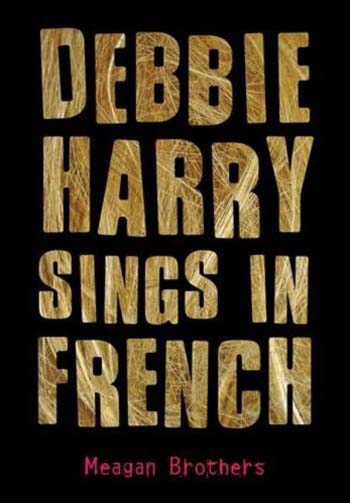
YA Co-Review: Debbie Harry Sings in French

h1 May 27th, 2008    by Eisha and Jules

Jules: Last week we talked gender politics and feminism à la E. Lockhart. This week it’s gender and sexuality and identity, issues deftly explored in the debut novel from Meagan Brothers, a Pushcart-Prize-nominated poet who, according to her bio, has made a name for herself in New York City’s spoken-word scene.

Apparently, this first novel of Brothers’, Debbie Harry Sings in French, is being released today (Henry Holt); Eisha and I shared an ARC of this title, which is why we’re able to tell you about it now (and the fact that we’re telling you about it on its very release day is a stroke of luck. We’re not normally this organized.) And, for the record, quoted excerpts in this post are subject to change, since we read an advance copy. Oh and also: As always, some plot spoilers are included below.

Brothers tells the story of sixteen-year-old Johnny. His father is dead, and his mother—as a result—descended into a depression she’s only now stepping out of when the novel opens. Johnny is picked on at his high school in Florida for wearing eyeliner and being all-around left-of-center, and he mostly hangs with his best friend, Terry. Eventually, Johnny ends up in rehab for alcoholism after his very own near-death experience (which impacts him — “some of the other Goth kids I knew were always talking about death in a weird, detached kind of way. It was like they wanted a zombie-movie version of it, not the real, messy, emergency-room version. I thought like that, too, for a while. But something changed, and I couldn’t think that way anymore.”)

Johnny’s mother sends him to live with his paternal uncle and his daughter (“Bug”) in South Carolina. It’s there that Johnny meets Maria. And Reading Rants put it so well that I must quote them here:
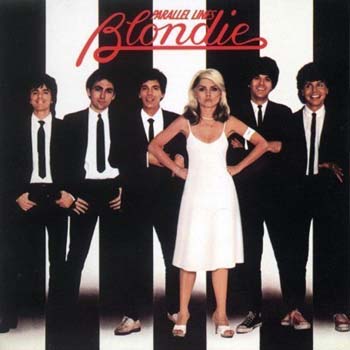
“It’s Love and Rockets at first sight, except for the troubling fact that Maria initially thought Johnny was gay. Why? Just because he likes to Robert-Smith-it up a little? Johnny knows he’s not gay, or he wouldn’t dig Maria so much. But what do you call it when you like girls, but you secretly want to try on that little white dress from the thrift store that looks exactly like the one Debbie Harry wears on the cover of Parallel Lines?”

I’m sorry, but that “Love and Rockets at first sight” bit made me happy. I used to be a fan when I myself was in high school.

So, right. Focus, Julie . . . Johnny falls for Maria and also falls hard for Blondie’s music (“Listening to Debbie Harry sing the French part of ‘Sunday Girl’ was somehow more reassuring than anything the counselors had told me so far”) — and Blondie’s “tough, but…really beautiful” stage presence. “It’s not like I just think of Debbie and, bang, I’m cured,” he tells his guidance counselor at school. “It’s . . . I dunno, meditation or something. If I’m in tough situation, I think about how cool and tough she is, and I try to be cool and tough, too.” Finding strength in that persona and how her music makes him feel, he eventually takes it a step further by dressing as her and, ultimately, entering a drag show. He also learns more about his father than he ever knew before while staying at his uncle’s.

So, what’d you think, Eisha? I was really wow’ed by this one, and if this is Brothers’ first book, I can’t wait to see what she does next. I’m probably getting ahead of myself, but there was one part of this book that I thought was so beautiful, I had to put the book down and just savor it for a moment. A great read overall, I thought. What about you? Read the rest of this entry »
7-Imp’s 7 Kicks #64: Featuring Barry Moser

h1 May 25th, 2008    by jules

Edited to add on Sunday night: I say, since folks were so busy today on this holiday weekend, that we leave this post up for a bit longer. If you are so inclined, feel free to leave your kicks on Monday, too (which you’re always welcome to do anyway)! Happy Memorial Day to all . . .
Edited to add on Monday: For a beautiful Memorial Day “Dedication,” go read Sara’s original poem.

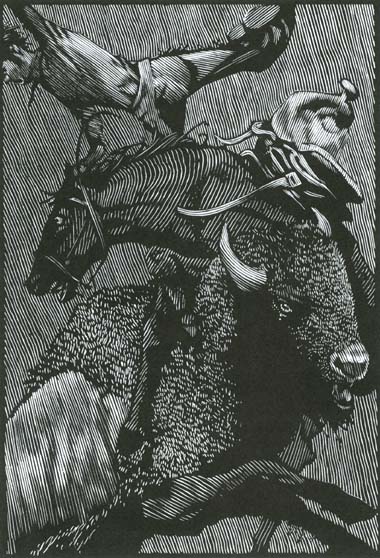
Jules: Well, howdy, friends. Put on your best bib and tucker, ’cause we’ve got art work from one ace-high illustrator this week, the one and only Barry Moser, whose woodblock-
engraving illustrations in last year’s Cowboy Stories (Chronicle Books; September 2007) are being featured today. I’ve had this book for a while and have been slowly enjoying it, particularly Moser’s highly dramatic, black-and-white illustrations — all line and shadow and heroism and wonder. Yes, this is a round-up of tales of the quintessential American icon, the cowboy — from authors such as Louis L’Amour, Annie Proulx, Dorothy M. Johnson, Elmore Leonard, and much more.

And one reason I’m sharing these images this week is that my father-in-law, a true cowboy at heart, had a bit of a spill this week — fell off a horse and broke some ribs. He’s going to be okay, but these images are for him and all the other cowboys and cowgirls who get right back up and get back on their horses—in more ways than one—after they’ve been thrown off.

Read the rest of this entry »

Seven Impossible Interviews #74
(Summer Blog Blast Tour edition):
Javaka Steptoe

h1 May 23rd, 2008    by Eisha and Jules

Javaka SteptoeWelcome to the fifth and final day of the Summer Blog Blast Tour. We hope you’ve enjoyed all the interviews as much as we have.
For our final SBBT interview, we’re thrilled to be talking with the hardest-working man in picture books: author/illustrator Javaka Steptoe. The talented Mr. Steptoe sprang onto the picture book scene in 1997 as the illustrator of the poetry anthology In Daddy’s Arms I Am Tall: African Americans Celebrating Fathers (Lee & Low). His mixed-media collages — created from “paper with pastel; applique; and a multitude of found objects, including fabric, coins, seashells, buttons, sand, seeds, and leaves” (School Library Journal) won him instant acclaim – and the Coretta Scott King Illustrator Award for 1998. As SLJ went on to say: “The artwork vibrates with emotion; even the simplest pieces, showing torn-paper figures on a solid background, capture the powerful bond between parent and child.”

Next up was the daunting task of re-illustrating a classic: Charlotte Zolotow’s sweet ode to siblinghood Do You Know What I’ll Do? (HarperCollins, 2000), originally illustrated by Garth Williams. The updated classic won Steptoe further accolades: Publisher’s Weekly raved “…His stunning illustrations… create layered, almost three-dimensional portraits of the striking African-American siblings. Their love for each other is tangible, yet he injects the same playfulness and humor inherent in the text.”

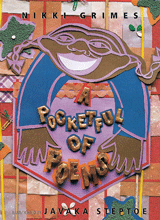
A Pocketful of PoemsSteptoe followed this up by collaborating with Nikki Grimes on the poetry collection A Pocketful of Poems (Clarion, 2001). School Library Journal praised the “playful and thoroughly successful pairing of words and pictures,” stating that his illustrations “give the book an urban, upbeat, and contemporary look.”

For his next project, Steptoe made the leap from illustrator to author/illustrator, in his original picture book The Jones Family Express (Lee & Low, 2003). The story of Steven, a boy who creates the perfect gift for his world-traveling aunt using a discarded model train and a lot of imagination, is the perfect vehicle for Steptoe’s collage art. Says SLJ: “Young readers will identify with Steven’s struggle to choose a perfect present and his excitement over Aunt Carolyn’s invitation for him to join her travels — but it is the illustrations that will cause them to linger over this book and delight in the colorful details.”

Read the rest of this entry »

Today’s Summer Blog Blast Tour Schedule

h1 May 22nd, 2008    by Eisha and Jules

Seven Impossible Interviews Before Breakfast #73
(Summer Blog Blast Tour Edition): Polly Dunbar

h1 May 21st, 2008    by jules

Polly Dunbar{Note: The rest of today’s Summer Blog Blast Tour interview schedule is posted at the bottom of this interview.}

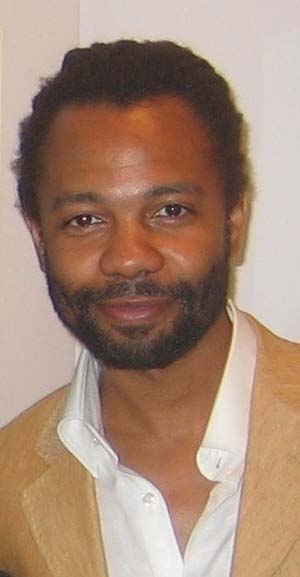
See Flyaway Katie on the book cover below, brought to life by illustrator Polly Dunbar? I’m about as excited as she looks, because Polly, pictured here, has stopped by 7-Imp today to chat with us. Polly—who lives and works in Brighton, England, and happens to have one of the most entertaining web sites of children’s lit— has a style all her own. Her books, both ones she’s illustrated and author/illustrated, are testaments to the power of a child’s imagination, and her energetic mixed-media illustrations, whose palettes are saturated with the loveliest of all colors, manage to be both spirited and cheerful and convey great depth all at the same time. And, in what seems to be a running theme this week, Polly has also talked in previous interviews about the freedom she feels in writing and illustrating for child readers:

I think the younger [readers] are, the more freedom you have with being experimental. Very young kids will accept anything. Their eyes are still so wide open. That’s why picture books for me are the most exciting area to work in.

I’ll show my work to a grown up, who will just sort of flick through it and say, “I like that colour.” A child will be absorbed in a different way, and that’s lovely and really rewarding.

Read the rest of this entry »

Today’s Summer Blog Blast Tour Schedule

h1 May 20th, 2008    by jules

Here is the interview schedule for today. Enjoy!

Here’s the schedule for the remainder of the week. Until tomorrow . . .

Seven Impossible Interviews Before Breakfast #72
(Summer Blog Blast Tour Edition): David Almond

h1 May 19th, 2008    by jules

{Note: The rest of today’s Summer Blog Blast Tour interview schedule is posted at the bottom of this interview.}
If you haven’t read anything by British author David Almond, here—in the words of reviewers who covered his first novel, Skellig, winner of the Carnegie Medal and Whitbread Children’s Novel of the Year Award as well as a Printz Honor—are some of the themes you’re missing: “the transforming power of caring and love” (Publishers Weekly); “worlds enlarging and the hope of scattering death” (NY Times Book Review); “loneliness, friendship and grace” (ALA; Printz Award Selection Committee); “the fearful, wonderful fragility of life” (author Richard Peck); “essential goodness, faith, truth, and love” (author Karen Cushman); and “miraculous happenings” (The ALAN Review). In their review of Almond’s first novel, School Library Journal best summed up what I think is Almond’s greatest strength as a writer: “The beauty here is that there is no answer and readers will be left to wonder and debate, and make up their own minds.” In their review of Skellig, the New York Times Book Review praised my second favorite thing about Almond’s writing: his subtlety.

Read the rest of this entry »

7-Imp’s 7 Kicks #63: Featuring Shadra Strickland

h1 May 18th, 2008    by Eisha and Jules

Jules: Welcome to our weekly meeting ground for listing Seven(ish) Exceptionally Fabulous, Beautiful, Interesting, Hilarious, or Otherwise Positive Noteworthy Things from the past week, whether book-related or not, that happened to you — as well as our meeting ground for featuring the work of illustrators.

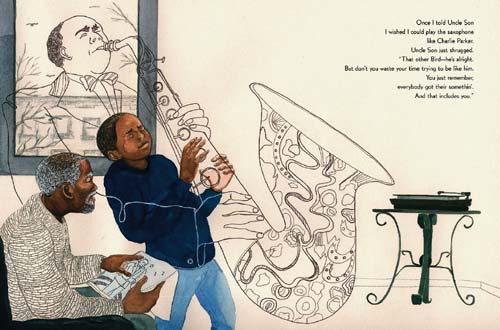
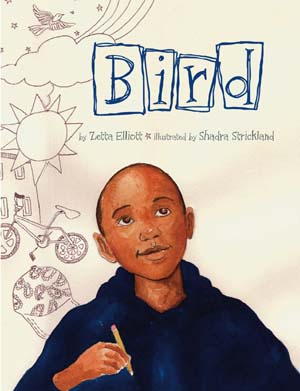
This week, we’re happy that Shadra Strickland has stopped by to share art work from her upcoming illustrated title, Bird, written by Zetta Elliott. Bird will be published this October by Lee & Low Books. This Publishers Weekly link tells us that the book will tell the story of a boy who struggles with his brother’s drug addiction and death through the support of his family.

Just in case you can’t read the text in the image above, I’ve made it a bit bigger for you here, and below that are three more images from the book: Read the rest of this entry »

Poetry Friday: Making a Fist

h1 May 16th, 2008    by eisha

This poem was my introduction to Naomi Shihab Nye. I don’t even remember how or when I came across it, but it has stayed with me forever after:

For the first time, on the road north of Tampico,
I felt the life sliding out of me,
a drum in the desert, harder and harder to hear.
I was seven, I lay in the car
watching palm trees swirl a sickening pattern past the glass.
My stomach was a melon split wide inside my skin.

“How do you know if you are going to die?”
I begged my mother.
We had been traveling for days.
With strange confidence she answered,
“When you can no longer make a fist.”

little fistClick here to read the final stanza, and to hear Nye herself give a reading of it.

I think this poem really showcases Nye’s economy of language. This poem is stripped of any unnecessary details: where they were going and why, what was really wrong with the poor kid… The line “My stomach was a melon split wide inside my skin” is all we need. Ten words, and I know exactly the kind of pain she’s in, and why she thought she was dying.

And then there’s the quiet power of the last line: “I who did not die, who am still living…” The last stanza acknowledges life’s hardships, but puts them in perspective when measured against the strength of a child’s fist.

* * *

The fine femmes at Two Writing Teachers are rounding up for this week’s Poetry Friday. Head on over and see what they got.

YA Co-Review: The Frankie Mystique

h1 May 15th, 2008    by Eisha and Jules

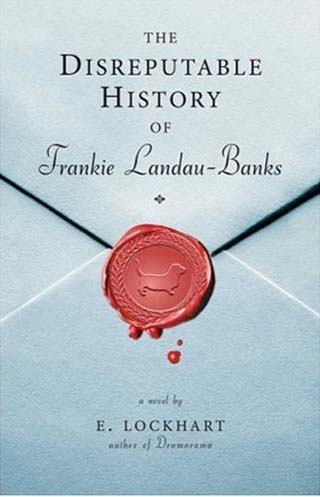
Jules: It’s been a little while since Eisha and I have done a straight-up co-review—just the two of us—of a YA title, but here’s one — E. Lockhart’s latest, at that: The Disreputable History of Frankie Landau-Banks (Hyperion, March 2008).

Fifteen-year old Frances Rose Landau-Banks—class of 2010 and otherwise known as “Bunny Rabbit” to her family—has just returned from summer vacation to Alabaster Prepatory Academy, the elite, competitive boarding school her father himself once attended. “Mildly geeky” before, she gained twenty pounds over the summer, “all in the right places,” and now has a figure that turns heads, the same brilliant mind and quick tongue she always did, and—this year—a new boyfriend, Matthew Livingston, a senior at Alabaster (though, as far as Frankie can figure out, “{t}he only thing {she} herself had done to facilitate the change was to invest in some leave-in conditioner to tame the frizz”).

Matthew’s circle of friends and social world, one of camaraderie, self-confidence, privilege, and ease, is one Frankie finds fascinating and non-existent amongst her female friends. While finding intriguing similarities between life on campus and Jeremy Bentham’s Panopticon she’s studying about in her Cities, Art, and Protest course, Frankie has her own internal struggles about being attracted to Matthew, who is smart, handsome, and often endearing but who also refuses to let her into his inner circle of friends. (Matthew even loves words like Frankie, who likes to play with what she calls her own imaginary neglected positives, or INPs, meaning you take a negative word or expression whose positive is almost never used, and you use it. Or “you impose a new meaning on a word that exists but, through the convolutions of grammar, doesn’t technically mean what you are deciding it means.” Think turbed from disturbed or criminate—from incriminate—which she uses to mean “give someone an alibi.” The latter example is a fitting one, indeed, since Frankie herself becomes somewhat of a criminal mastermind herself during the course of the story.)

When she finds out that Matthew and his friends all belong to the Loyal Order of the Basset Hound, a secret society to which her own father belonged when he was a student years ago, Frankie’s interest is piqued. However, not only will Matthew and his friends not let her join; Matthew avoids the subject altogether, never once telling her about it. Thus challenged, she formulates a plan to anonymously work her way into the Bassets and convince them to perform a series of pranks on the school, ones which challenge the status quo socio-political atmosphere on campus. And she does this for many reasons — but primarily because she was tired of being Bunny Rabbit:

Not a person with intelligence, a sense of direction, and the ability to use a cell phone. Not a person who could solve a problem . . .

To them, she was Bunny Rabbit.

Innocent.

In need of protection.

Inconsequential.

* * * * * * *

So, Eisha. This was my first E. Lockhart book. Gasp! I really liked it. I did not expect the teen-feminist underpinnings (is she known for such things, and I’m just really slow?), and I really liked it. What’d you think? To say we have nui for this book (the neglected positive of ennui) doesn’t really follow Frankie’s grammatical rules for such creations, I suppose.

I guess I should quickly warn first: Some plot spoilers below.

Carry on, then.

Read the rest of this entry »