Archive for the 'Interviews' Category

Some Impossibly Beautiful Needlework
Before Breakfast: Interview with Illustrator
Salley Mavor (the Winter Blog Blast Tour Edition)

h1 Tuesday, December 7th, 2010

{Quick note for any newbies: Blog blast tours are when many children’s-book bloggers interview children’s and YA book authors over the course of a week, following one huge master schedule—which I’ve included at the bottom of this post—and we all get very link-happy and post about one another’s interviews in an effort to spread the word about great books. Enjoy.}
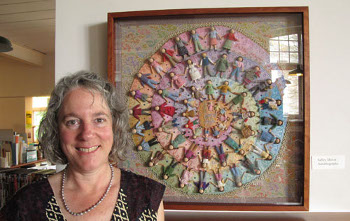
This September, illustrator and creator-of-beautiful-images, Salley Mavor, brought readers A Pocketful of Posies: A Treasury of Nursery Rhymes (Houghton Mifflin), and it truly is one of the most outstanding picture books you’ll see this year (in my enthusiastic opinion). A 64-page volume of classic nursery rhymes, Salley painstakingly and stunningly rendered all of the illustrations in needlework, what she calls her fabric relief collage. And it’s a jaw-dropper of a picture book. If you haven’t seen Salley’s work before now, let this be the first book of hers you see. “Rarely have classic childhood verses been depicted with so much care and detail — and fabric,” wrote Publishers Weekly. “Loosely organizing the rhymes over the course of the day, starting with morning themes and closing with bedtime rhymes, Mavor creates a miniature world using wool felt, various stitching techniques, and found materials like acorn caps and seashells… Mavor’s intricate and colorfully embroidered work of art makes even the best-known childhood poems feel special and new again.”
Read the rest of this entry �

On Nailing the Kid-Friendly: Author Cynthia
Leitich Smith — With Lots of Art from Barry Gott

h1 Wednesday, December 1st, 2010

(Hoo boy. I haven’t had my coffee yet this morning, but I think I’m awake now. How ’bout you?)

My oldest child screamed as a baby. A LOT. No, I mean really. People say that about their kids, but I mean to tell you it was for no discernible reason and at all times. To the notion of the “witching hour,” or babies crying for the same period of time every day in the early evening, she gave the middle finger and said she could do it way better and longer. Unless mama was holding her. If not, she was taking it out on the world somethin’ fierce. It’s like she created her own kind of whacked-out colic — to some kind of pathological degree, or so it seemed at that time. (Dr. William Sears has a name for this, which comes closer to anything else I’ve ever read and rather saved me at that time, and for that reason, I will hug that man’s neck if I ever meet him. But I digress — and remarkably so.)

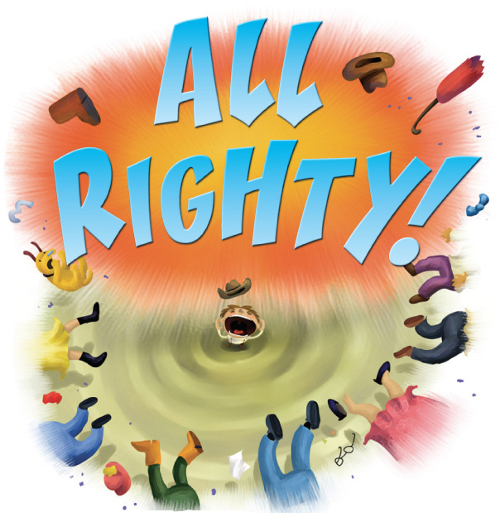
Pictured above in that invigorating illustration is Holler Loudly. He would have put my screamin’ wee babe to the test. Not to mention his tall-tale adventure is much funnier.

Read the rest of this entry �

Seven Questions Over Breakfast with Richard Holland

h1 Tuesday, November 30th, 2010

I pulled this “seven questions over breakfast” illustrator interview series out of the air in 2008 (with the wonderful Jeremy Tankard as my first victim) precisely for folks like British illustrator Richard Holland, visiting me this morning for a coffee
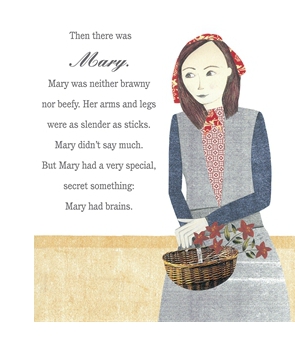
Q & A. Essentially, I wanted to have a covers-the-basics questionnaire handy in order to shine the spotlight on new illustrators in the field of children’s lit—to get a quick overview of what they’ve done and where they’re heading—and Richard fits snugly into that category. New, that is. He’s illustrated five titles thus far in his career, and it was his collage work on Jan Mark’s The Museum Book and Martin Jenkins’s The Time Book (both released by Candlewick in 2007 and 2009, respectively, after first being released in the UK) that caught my attention. This year, he also illustrated Tanya Landman’s Mary’s Penny (also Candlewick), a re-telling of a traditional fable, pictured below. (“Soft colors and the lightest of lines echo the gossamer touch used to deliver the feminist moral,” wrote Publishers Weekly.)

If you haven’t seen The Museum Book and The Time Book (both nonfiction titles), you’re in for a treat. I suppose it all comes down to personal preference, but I say that, even if you’re not a fan of collage, Richard might change your ways. Publishers Weekly wrote about his mixed-media collage work in The Museum Book, “Holland…jolts readers…with his mixed-media collages, which sparingly employ color and liberally combine what look like Victorian engravings, pencil sketches, Gorey-like figures, and photos of various locales. His stylish compositions play with perspective, type and design, making excellent use of the vertically oriented pages…” These are spreads to pore over, taking in Richard’s creative interpretations of our histories of both collecting and watching our clocks. Read the rest of this entry �

Seven Questions (Times Two) Over Breakfast
with Author David Elliott

h1 Tuesday, November 16th, 2010


“In burning sun, / in blinding snow, / there stands the mighty Buffalo. /
His temper short, / his suffering long — / once was sixty-million strong. /
In burning sun, / in blinding snow, / behold! The mighty buffalo!”
(Click to enlarge slightly.)

At his web site, children’s book author David Elliott writes, “Books are…about language: its rhythms and its music; its stops and its starts; its noises and its silences; its unending layers of meaning. I’m not always as successful as I’d like to be. Still trying to get it right.” I’d say David has gotten it right more than a few times. He has penned several picture books, as well as middle-grade novels for kids, many of which I have enjoyed over the years as a librarian and with my own children. (Here is a comprehensive list of his titles at his site.)
And there are many reasons I enjoyed this interview with David—I was quite enamored with his thought-provoking responses to several of these questions, for one—but the best thing that came out of it was re-discovering my love for his two poetry picture book titles, On the Farm and In the Wild, both illustrated by Holly Meade. The latter was released this August (Candlewick), and as I formatted this interview, I fell in love all over again with the poems in the book, as well as with Holly’s luminous woodcut and watercolor illustrations. The above spread is from this collection of verses. School Library Journal writes, “Elliott’s spare verses vary in length and form with bits of humor {and} some lovely use of language and imagery.” Elizabeth Ward wrote about the first collection of poems (The Washington Post), “Elliott’s little verses pack a deceptive punch.”

David’s here for a breakfast interview. I’ve got the cyber-coffee on, and we’re ready to chat. I thank him for stopping by to talk about a little bit of everything regarding his work as a children’s book author and poet — humor in children’s books, the joy of having a good editor, the art of listening, not undervaluing children, the challenges of writing picture books for the very young, the “imposter syndrome” of a writer, how prose picture books are like eggs, what is most liberating to him in his writing, and (my favorite part of all) still feeling as scared and awed by the world as he did as a kid. Oh, and lots more . . .

Read the rest of this entry �

Cristiana Clerici’s International Spotlight #2:
An Interview with Illustrator Eva Montanari

h1 Tuesday, November 9th, 2010

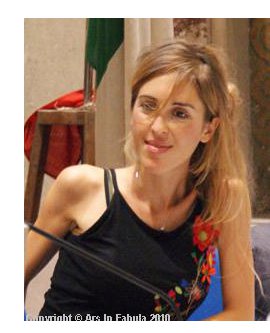
I may not be able to fly to Italy and have coffee with the ebullient and very smart children’s-lit blogger Cristiana Clerici (pictured below), as I’d like to do, but every once in a blue moon I pull myself together and have something that might resemble a clever idea. And in September of this year, it was to invite Cristiana to 7-Imp, whenever the mood strikes her, to help me shine the spotlight on international picture book titles. Real coffee and meeting Cristiana in person would trump cyber-coffee any day, but I take what I can get. To get the low-down on what I’m calling Cristiana Clerici’s International Spotlights, visit this page of the site.

Today, Cristiana makes blogging easy for me, as she sent me the content for the below interview with Italian author/illustrator Eva Montanari (pictured right), and I had the distinct pleasure of formatting the images and text. The rest is all Cristiana — and Eva, of course, who muses on the creative process; her teaching and turning the “modest and inspired doodles” of her students into narrative threads; exploring the new territories of her art; rediscovering childhood joys in her illustrations; the joys (yes, joys) of making mistakes in one’s art; and lots more. So, I turn the keyboard over to Cristiana (who not only conducts these interviews, but also then translates them for us readers), and I thank her and Ms. Montanari for their contributions to 7-Imp and picture book discussions.

Cristiana: Last summer, I went to Macerata, where illustration classes are held for those who would like to become children’s books illustrators. I had been invited by Ars In Fabula, who organized those courses, to see how their Master works, since it had already brought about excellent results (for instance, just to mention the most recent ones, La Governante by Sara Gavioli, or the new version of I Promessi Sposi by Umberto Eco, published with Scuola Holden and illustrated by Marco Lorenzetti). Read the rest of this entry �
Peter Brown Makes One Really Good Book
About How Children Make Terrible Pets*

h1 Monday, November 8th, 2010


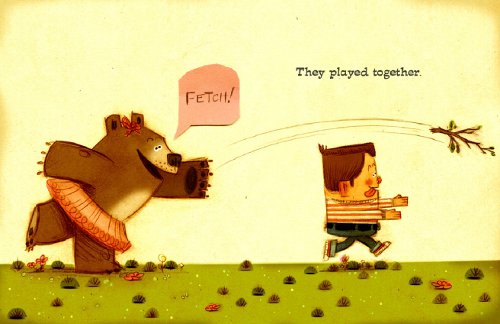
(An earlier, experimental spread from Peter Brown’s Children Make Terrible Pets)

* {Ouch. I know. These are the kinds of unforgivably uncreative post titles you get before I’ve had the sweet brown life blood that is my coffee and when you get as little sleep as I got last night.}

Please allow me, dear readers, to be fixated just one more day on the New York Times Best Illustrated Children’s Books of 2010 list, announced last week. Yesterday, I featured some spreads from Suzy Lee’s Shadow, and today Peter Brown is back to talk a bit more about his 2010 title, which also made the NYT list, Children Make Terrible Pets (Little, Brown, September 2010). You may remember Peter discussing it (and sharing early spreads and sketches from it) in my April interview with him.

Read the rest of this entry �

Seven Impossible Interviews Before Breakfast
# Oh-I’ve-Just-Stopped-Counting: J. Patrick Lewis

h1 Tuesday, November 2nd, 2010

I’m sorry for the field of Economics, but happy for children’s literature, that J. Patrick Lewis, once upon a time, jumped careers. Yup, Lewis, who goes by Pat, was a Professor of Economics for thirty years — before devoting himself to full-time writing. I hate to use such a clichéd phrase (do authors roll their eyes at it?) but just have to introduce him by saying I think he’s a national treasure. Truly. If I’m counting correctly, he’s about to hit the 70 mark, as in he’s written almost 70 books, mostly poetry collections, for children. He’s been honored by the American Library Association and the Society of Children’s Book Writers and Illustrators and has established himself as one of this country’s most distinguished children’s poets and authors. He has earned wide acclaim for the vivid language (whether sophisticated and poignant or light-hearted and nonsensical) and lyrical writing of his poetry, written in a wide-range of styles and covering seven skerjillion (to be precise) subjects; his passion for visiting schools and working with children (“Getting children excited about the wonders of poetry—experiencing literature—is the reason I visit schools in the first place,” he writes at his site); and his work that consistently “respects the music of the written word” (also taken from his site). As Booklist once told it like it is, he is simply a “fine poet,” and School Library Journal once wrote, “no one is better at clever wordplay than Lewis.”
And BOY HOWDY have I wanted to have him visit 7-Imp for a long, long time now. And I enjoyed chatting with him so much that I’m going to get right to it. Not surprisingly, I’ve included as much art as I can in this post, including some spreads from two of his latest picture books. Enjoy. And I thank Pat for stopping by and having virtual coffee with me.

Read the rest of this entry �

A Quick Cup of Coffee with Roger and Martha
and a Peek at A Family of Readers

h1 Thursday, October 28th, 2010

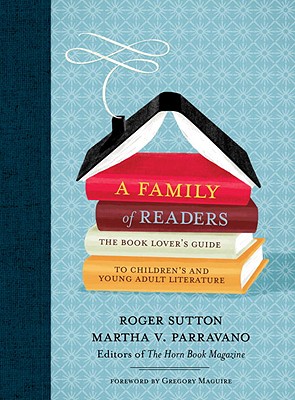
I’ve got three coffee cups out this morning to tell you what book has, arguably, replaced this as my favorite gift for friends having babies (well, maybe I can get both books for them), not to mention anyone who tells me they want to study children’s literature. In September, Candlewick released A Family of Readers: The Book Lover’s Guide to Children’s and Young Adult Literature, written by Horn Book editor Roger Sutton and executive editor Martha V. Parravano. It’s a wonderful read, and the book’s very premise was a smart one: As Roger writes in the introduction, “your passion for reading isn’t necessarily accompanied by a knowledge of children’s books, and that’s where we come in.”
As the sub-title tells you, this is a guide to children’s literature for those families passionate about reading — yet who may not know how to navigate the sometimes overwhelming world of children’s lit. “It is a book,” he writes later, “for readers, people who need books as much as food or air, and whose idea of the perfect vacation and/or evening meal is to have more time to read.” Even calling it a “guide” is somewhat misleading. To be sure, it’s a guide, yes. But this isn’t your go-to book for those parents who don’t read and suddenly decide they want their kids to. Don’t expect shallow lists of how-to’s and what-to-read’s (or, as Roger writes, “not bland lists of dos, don’ts and surefire recommendations”). Refreshing, indeed. This is a collection of well-crafted essays (Naomi Shihab Nye on poetry, Jon Scieszka on humor, Mitali Perkins on girl books), many previously printed in The Horn Book, about children’s literature, touching mainly upon, as Roger writes, how to give children the skills and opportunities to read, how to create books that both interest and respect them, how to allow children ownership of their reading, and how to know when and how to guide young readers, as well as knowing how to leave them alone already, when they need it. Read the rest of this entry �

One Picture-Book Roundtable Discussion
Before Breakfast #2: Featuring Author Tammi Sauer, Illustrator Scott Magoon, and Editor Alexandra Penfold

h1 Tuesday, October 26th, 2010


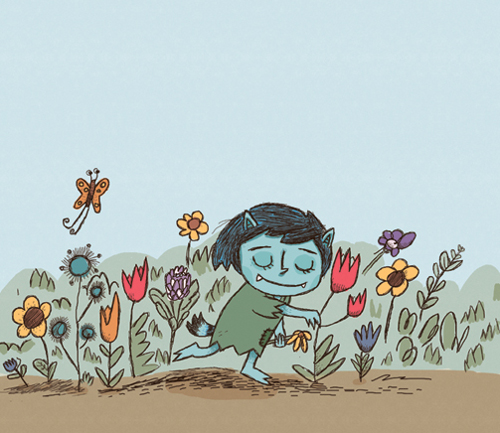
“…she liked to pick flowers.”

I had so much fun hosting this first-ever picture book roundtable discussion in August that I decided to do it again. Not only that, but to make it a regular feature of sorts. And I have author Boni Ashburn, you may remember, to thank for the very idea.

When Boni, Kelly Murphy, Maggie Lehrman, and Chad Beckerman visited that day, I had the author, illustrator, editor, and art director/book designer on deck to give me and 7-Imp readers varying perspectives on one picture book title. It was a great read, I thought. Today, we have the author, illustrator, and editor of another picture book title. The book’s designer, Lizzy Bromley (Simon & Schuster), isn’t currently available to weigh in, but we decided to forge ahead anyway. (Maybe we can catch Lizzy another time.)

Read the rest of this entry �

One Visit with Candace Fleming and Clever Jack
Before Breakfast (Served with Golden-Sweet Cake
and Succulent Strawberries)

h1 Wednesday, October 20th, 2010


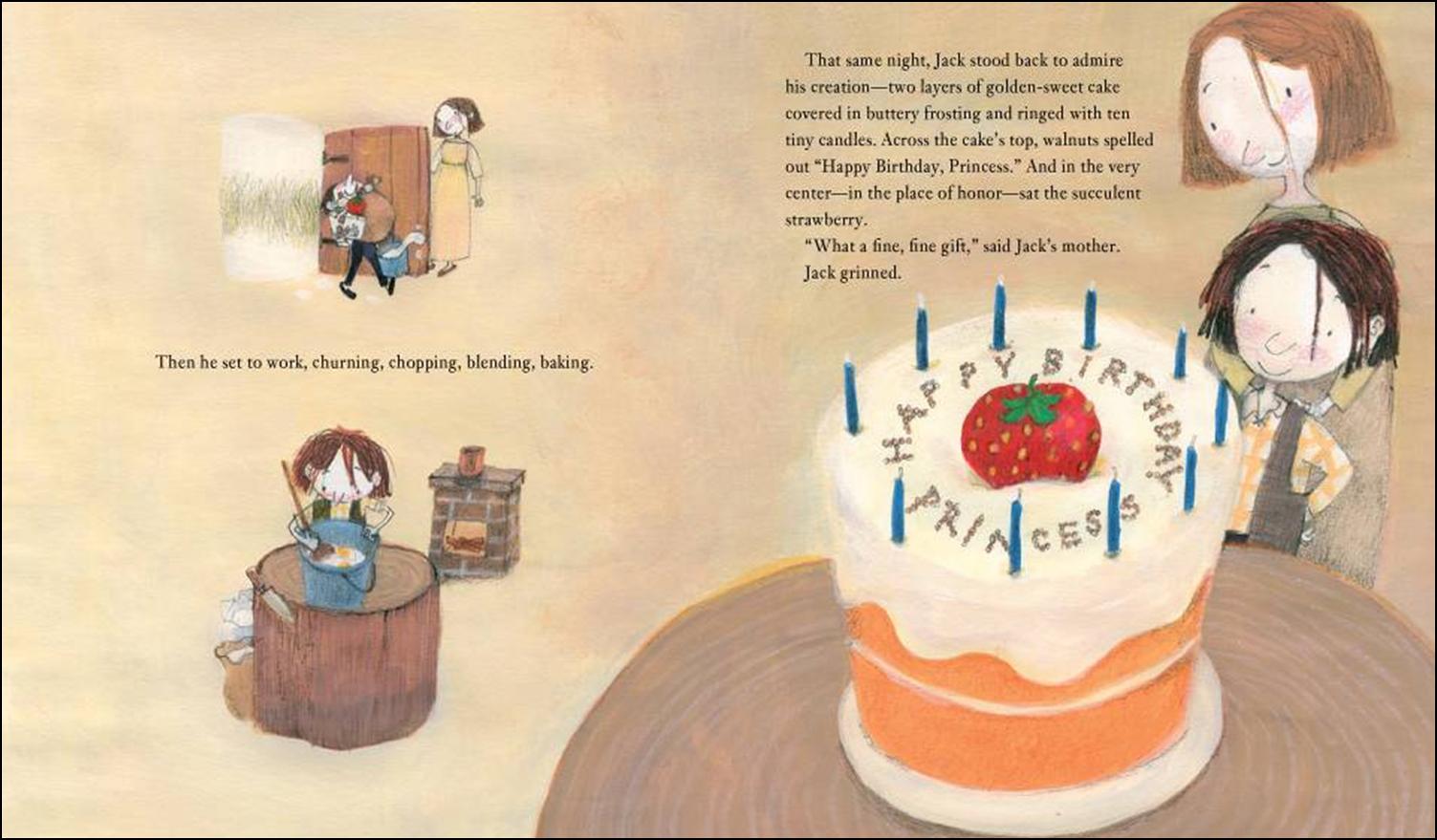
(Click to enlarge and see spread from which this illustration comes.)

This morning’s post is dedicated to a new picture book, Clever Jack Takes the Cake (Schwartz & Wade, August 2010), which jumped up and surprised me and was placed, soon after I first read it a few weeks ago, in the Top 10 Jules’s Favorite Picture Books of 2010 list in my noggin. I know: I speak in hyperbole. Is anyone actually keeping count of my 2010 favorites? Really, though. Hyperbole aside, this book is a winner on so many levels that it is a true joy to read. And I just noticed that it’s been met with a whole host of starred reviews, so it looks like I’m not alone in my adoration for it. (“The creators of Muncha! Muncha! Muncha! celebrate storytelling with a sparkling specimen of that very thing,” writes Publishers Weekly.)

Read the rest of this entry �